

Nolinor Launches a New Service for Businesses
Nolinor Aviation will now operate aircraft owned by its clients Our clients bring their aircraft and their mission, and we take care of...
Read more

Everyone knows the tricks for getting cheap airline tickets. Book on a Tuesday. Clear your cookies. Set a price alert and wait. Some of these actually work. Airlines use dynamic pricing, and timing can save you a few hundred dollars on a flight to Cancún.
But when your transport problem is a crew rotation moving 100 workers to a mining site north of the 51st parallel, none of that applies. Charter aviation runs on a completely different cost logic. There are real levers you can pull. Most operations managers just don’t know they exist.
In charter operations, the customer sets the departure time. That sounds like an advantage. It is, until you pick the wrong one.
Flight crews operate under strict duty time limits set by Transport Canada. A duty period starts when the crew reports for work, typically about an hour before departure, and ends when the aircraft is parked and shut down at the final destination. The maximum length of that period depends on two things: the time of day the crew starts working, and the number of flight legs in the mission.
The numbers tell the story. A crew reporting at 7 a.m. for an 8 a.m. departure with one to four legs gets up to 13 hours of duty time. That same crew, called in at midnight for a 1 a.m. departure, gets 9 hours. Four hours of usable mission time disappear just because of when the clock starts. Everything flows from that window. Choose a departure time that gives your crew a full duty period, and they can complete the entire rotation in a single day: multiple stops, crew drop-offs, the return leg. One crew, one aircraft, one day. That’s the leanest operation possible.
Now compress that window. Pick an early morning or late evening departure, and the available duty time shrinks. If the crew can’t complete the route within their limit, the operator needs a second crew. That second crew has to be positioned at a handoff point, which means additional flights, hotel rooms, ground transport. Your one-day operation just became a two-day operation with double the crew cost.
Even when the route technically fits inside the duty window, a tight margin is a problem. Say you land with 30 minutes of duty time left and the weather closes in at your next stop. There’s no buffer. A one-hour weather hold becomes a full disruption: the crew times out, a replacement crew has to be sent, your rotation schedule takes a hit. If you want to succeed in a northern environment, you need flexibility built into your schedule, not scraped from the margins.
Choose a departure time that maximizes the duty window. When things go as planned, you save on crew and aircraft costs. When they don’t, you have the margin to absorb a delay without blowing up the schedule.
Charter has its own version of peak pricing, and it has nothing to do with algorithms.
Tuesday, Wednesday, and Thursday are the high-demand days for charter rotations. Most mining and industrial clients schedule their crew changes midweek. On those days, operators need more aircraft and more crews to meet demand. That additional capacity costs money, and it gets passed through to the customer.
Shift your rotation to Monday, Friday, or the weekend, and the picture changes. Demand drops. More aircraft sit available. More crews sit available. The operator doesn’t need to add an extra airframe to the fleet, along with the pilots, maintenance, and positioning that come with it, just to serve your schedule. You get better pricing because you’re using capacity that already exists instead of forcing the operator to create more.
Same supply-and-demand principle that makes a Sunday evening flight to Toronto more expensive than a Wednesday morning one. The difference is that charter clients can design their schedules. The ones who think about fleet-wide demand when they do it pay less.
Most cost analyses get this wrong. They compare flight prices. The real number is total transport cost per passenger per rotation, and the flight is only one piece of it.
Consider two options for the same route. Option A is a Boeing 737-200, a larger jet built for short northern runways. It costs more per flight, but it carries your full crew rotation in one leg, flies faster, and doesn’t need a fuel stop. Option B is a smaller prop aircraft at a lower per-flight price. But that smaller aircraft may not fit your entire rotation in one load, so now you need two flights. Or it needs a refueling stop en route, which adds roughly an hour per stop because it’s a detour. Every fuel stop burns crew duty time and adds cost, because you’re paying for the crew the entire time they’re on board.
When you calculate the total cost per passenger, the math often favours the larger aircraft. Two flights on a smaller plane, or one flight with a fuel stop and tighter duty margins, can add up to more than a single direct run on a 737. The per-flight price is higher, but the cost per seat across the full rotation is lower.
Reducing charter transport costs comes down to planning, not negotiation. The operators who give you the best price are the ones you’ve given the best conditions to work with.
Start with departure timing. Work with your operator to find the window that gives crews the most duty time and the most flexibility to handle the unexpected. Ask whether midweek departures are a requirement or just a habit. If you can shift to Monday, Friday, or even the weekend, you may find better availability and pricing without changing anything else. And when you evaluate proposals, compare total transport cost per passenger, not flight cost. A direct route on the right aircraft, even at a higher hourly rate, often wins once you account for the full rotation.
The people who pay less for charter aren’t better negotiators. They’re better planners.
Stay up to date with the latest news related to our industry, check out our latest news.
Nolinor Aviation will now operate aircraft owned by its clients Our clients bring their aircraft and their mission, and we take care of...
Read more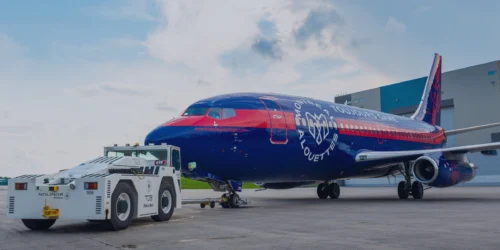
Nolinor Aviation est fière d'annoncer que tous les vols qu'elle opère au nom des Alouettes de Montréal porteront désormais le numéro de vol NRL425. Ce n'est pas un simple changement administratif : c'est un...
Read more
Canadians know how to build on ice. Every winter, thousands of outdoor rinks are built the same way across the country: clear the snow, flood the surface, let it freeze, [...]
Read more
Nolinor Becomes First in Canada to Deploy SKYTRAC’s TrooTrax Mission for GADSS-Ready Tracking Mirabel, Québec, January 20, 2026 – Nolinor Aviation (Nolinor) has selected SKYTRAC Systems Ltd.’s (SKYTRAC) TrooTrax [...]
Read more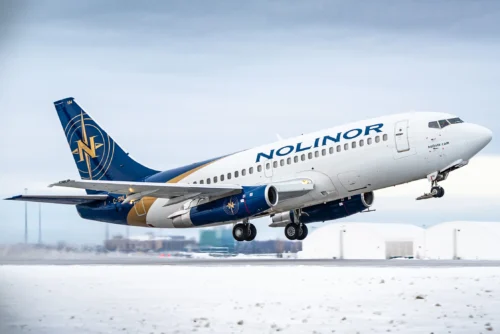
The dominant narrative in aviation is that older aircraft are, by definition, nearing retirement. Calendar age is routinely treated as a proxy for safety, reliability, and economic relevance. In industrial [...]
Read more
Service offered
in America and Europe
Charter and cargo operations across the Americas and Europe

UN approved
carrier
Certified for United Nations humanitarian operations

Official
carrier
Official carrier of the Montreal Alouettes — CFL

International Aviation Safety Program
Aviation safety audit — the industry's highest standard