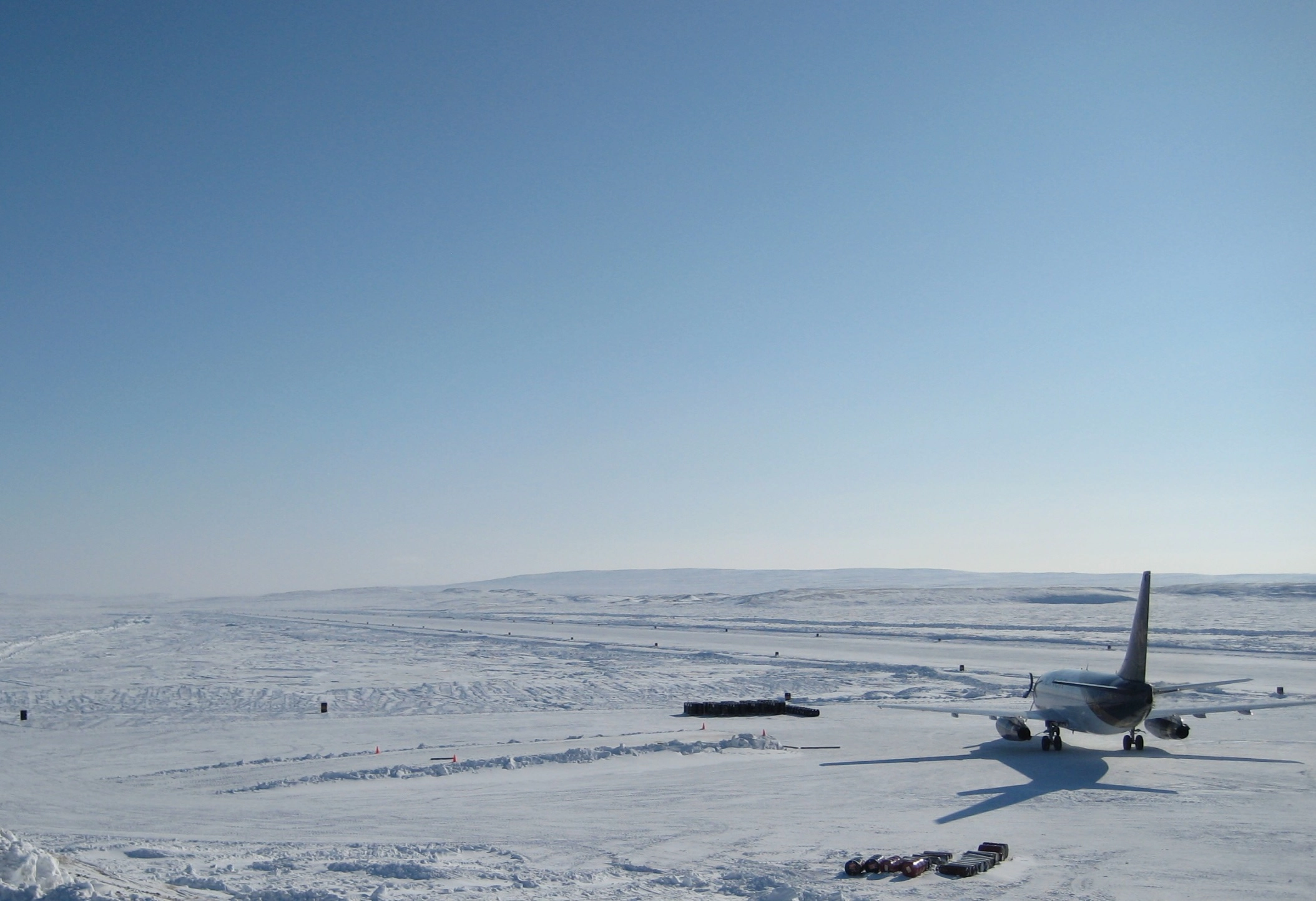
Canadians know how to build on ice. Every winter, thousands of outdoor rinks are built the same way across the country: clear the snow, flood the surface, let it freeze, repeat. An ice runway is the same principle scaled up. It is a prepared surface on a frozen lake, built layer by layer, engineered to support aircraft instead of skaters. It is one of the most Canadian pieces of infrastructure imaginable, and it has been quietly enabling the development of northern projects for decades.
Ice runways are not makeshift. They are engineered infrastructure, governed by Transport Canada regulation, and backed by over 70 years of military and industrial use. They have supported the construction phase of some of Canada’s most significant northern operations: projects worth billions of dollars, built at sites where no permanent infrastructure existed when development began.
At Nolinor Aviation, ice runway operations are part of our specialized expertise. Our Boeing 737-200 fleet is purpose-built to operate on ice and gravel. When a client needs to deliver heavy cargo to a remote location with little to no infrastructure, the ice runway is what makes that flight possible. Without it, the same tonnage requires numerous small-aircraft sorties at multiples of the cost and a fraction of the speed.
The northern access problem
Canada’s North is rich in mineral deposits, energy resources, and critical infrastructure projects, but poor in transportation access. Year-round road access is nonexistent for the vast majority of project sites above the 55th parallel. Most sit hundreds of kilometres from the nearest road or port connected to southern Canada. Seasonal winter roads can bridge that distance, but they come with their own constraints: the permitting process is lengthy, the environmental footprint is significant across vast stretches of tundra, wetlands, and waterways, and the construction and operating costs scale directly with distance from the existing road network.
During exploration, small aircraft such as seaplanes, skiplanes, and helicopters can reach almost any site. But they move people and light cargo, not the volumes required to transition from exploration to construction. When the project reaches the point where it needs to move millions of litres of fuel, heavy machinery, and construction materials, the economics of small aircraft simply do not scale.
An ice runway changes the equation. One lake of sufficient size near the site, with no linear corridor across hundreds of kilometres of sensitive terrain and no multi-year environmental review for a road route, and the project has access to large aircraft such as the Boeing 737. That means enough cargo throughput to deliver the materials needed to build the permanent airstrip that unlocks year-round operations.
That is what ice runways do. They enable the shift from exploration to construction. They are the first link in the chain that connects a remote site to the infrastructure required to develop it.
The cargo multiplier
The economic case for ice runways comes down to aircraft size. A Boeing 737-200 on an ice runway delivers an order of magnitude more cargo per flight than the small aircraft typically used during exploration. That ratio, roughly ten to one, changes the equation entirely. For a northern project transitioning into construction, consuming millions of litres of diesel, tonnes of steel, camp modules, and processing equipment, this multiplier is decisive. It is the difference between a logistics plan that can deliver the volumes required to build a permanent airstrip, and one where costs spiral long before you get there.
The environmental comparison matters too. One large-aircraft flight replaces ten or more small-aircraft sorties. Fewer flights mean fewer emissions, less noise, and less total traffic over sensitive northern ecosystems. For projects operating under environmental scrutiny, consolidating cargo onto fewer, larger flights is not just economical; it is a better environmental outcome.
A properly constructed ice runway can support any aircraft type, but operating safely on ice demands specialized expertise that most carriers do not have. Nolinor has been flying to ice and gravel strips across northern Canada for decades. That operational depth, combined with the 737-200’s versatility on unprepared surfaces, is what makes the cargo multiplier real, not theoretical. We examine the aircraft’s continued relevance in The Boeing 737-200: Built to Last.
Proven at scale
Ice runways have supported the development of some of Canada’s largest northern operations. In Nunavut, a 2,400-metre ice runway on a frozen lake provided large-aircraft access during a major mine’s development phase. That site now includes a permanent gravel airstrip capable of handling Boeing 737 aircraft. In the Northwest Territories, a temporary ice airstrip supported fuel delivery and resupply during exploration before a permanent gravel runway was constructed as part of the project’s full development. At another Nunavut operation, a seasonal ice extension onto an adjacent frozen lake increases effective runway length during winter months, enabling larger aircraft to operate at higher payloads than the permanent strip alone would support.
Whether as standalone strips or seasonal extensions of permanent infrastructure, ice runways provide the cargo access that supports early development and expands operational capacity at remote sites. They do not replace gravel strips; they complement them. The case for gravel as the long-term northern aerodrome solution is examined in The Benefits of a Gravel Runway and Why It’s a Long-Term Solution.
Plan for ice from the start
Ice runways should not be an afterthought in northern project planning. They should be evaluated at the feasibility study stage, the moment a company begins asking how to get construction-phase volumes of cargo to a remote site.
At Nolinor, we do more than fly to ice runways. Through our partnership with Cirrus Intelligence, we offer the full scope of capability, from ice aerodrome feasibility assessment and engineering through to construction management and flight operations. One call, and the entire logistics chain is covered.
We operate the world’s largest fleet of Boeing 737-200s and have decades of experience delivering cargo to ice strips, gravel strips, and remote aerodromes across northern Canada. If your project requires heavy-lift air access before permanent infrastructure exists, contact us. We will help you get your project built.